
Broken Limbs
Fragments: A series of short memories that made me

Eleven years old, in the sixth grade, and I was full of dread.
The Family Tree assignment.
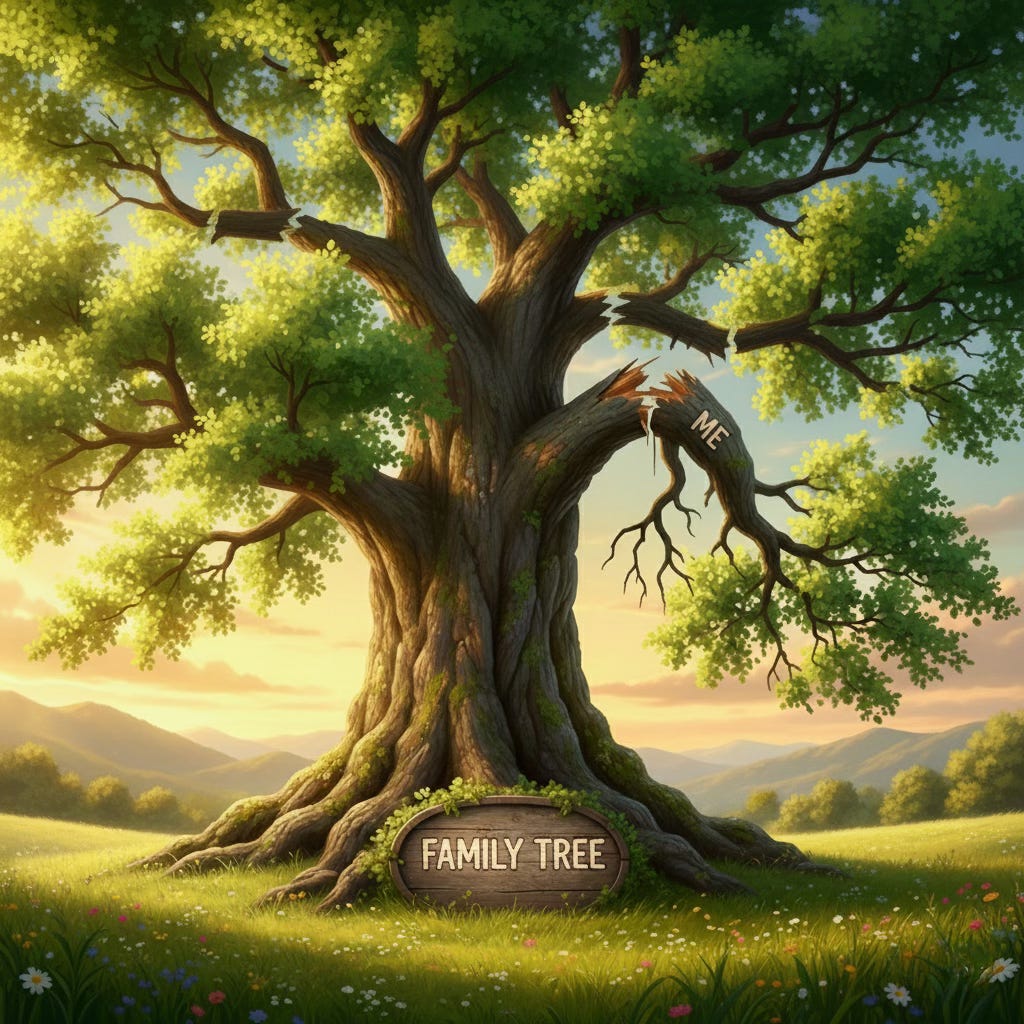
I had done it before in my elementary school career and so the pit in my stomach was a familiar one. It was an echo of shame that lived somewhere between my ribs.
“Draw and describe the history of your family,” the teacher said. “Your ancestors. The people you came from.”
It should have been fun, an invitation to connection, to belonging. But for me, it was a test I already knew I would fail. Because I couldn’t stop at just my grandparents and aunties and uncles and cousins. It was required that I go deeper, further. I had been told stories of distant family, but immediate relatives was all I could write about, by myself.
When I asked my father for help, he punted. Dodged. Kicked the can.
“Call my sister,” he said. “Ask her about the grandparents, the great-grandparents, the great-aunts and uncles.”
My eleven-year-old self was expected to cold-call a relative I barely knew? I was suddenly a detective in a faraway family. My father was a boastful black sheep, and I was supposed to collect the stories from the flock that had already shunned him.
Would my aunt have offered help freely? Or would she have resented the request, the free labor, while thinking of all the borrowed money my father had never returned?
My mother, meanwhile, is a blur in this memory. I don’t remember if I ever asked her about her side of the family. Sadly, she was second place in our family patriarchy. And she had receded into the background. She was back to work, singing jazz in nightclubs, getting good reviews, present but slightly disengaged.
At eleven, I had already learned secrecy. Already built an inner world to hide in. A place where I answered my own questions when no one else would. Or self-soothed with my own tears. Or my own make-believe. I would keep these feelings and thoughts to myself.
The assignment made my cheeks flush. I felt hot. Embarrassed. Ashamed.
My school—Decatur Classical Elementary, a gifted magnet program in Chicago—had some cultural diversity in the student body but I had never met anyone with my unique background. No one else had a Puerto Rican mother and a Jewish father. No one else seemed to carry a last name that was hard to pronounce, identifiably Jewish, yet lived in a home where Spanish hovered like an unclaimed inheritance (with an equally challenging and mispronounced surname.) No one else seemed to live between worlds. Between cultures. There may have been others driving on a two-way cultural highway in mainstream America, but how would I know? No one talked of those things then.
“You don’t look Puerto Rican,” people would say. Family. Neighbors. Everyone.
What an unusual combination. It’s a shame you aren’t fluent in Spanish. You’re not really Jewish unless your mother is.
“You’re a half-breed,” my father said his relatives called us.
But did they? Or was that his story, his justification for the rift he’d created?
How was I supposed to call those same relatives, to piece together a lineage I’d been taught didn’t want me? Or at the very least didn’t see me as fully one of them?
You see, my parents were born in the 1930s, raised during the Great Depression and WWII and when assimilation was survival. National identity trumped ethnic identity; you may have practiced your prayer to your people in the privacy of your own home, but blending in to society at large was the safest path forward. Manners, education, proper pronunciation and enunciation, code switching… these were our finely honed tools.
We may not have been born into wealth or Plymouth Rock privilege and my parents may have been first generation Americans, but we would never let them say we didn’t belong.
Never again. The battle cry of the Jewish diaspora. ¡Pa’lante! para los Boricuas.
They had experienced firsthand the indignity and pain of bigotry and exclusion. Antisemitism. Xenophobia. Kike. Spic. White passing but never a WASP (White Anglo-Saxon Protestant). Would they ever let you be a part of them once they knew what you were and where you came from?
They were fitting into the United States of America, yet they also wore their otherness like a badge of honor. Beatnik rebels giving the finger to the squares.
Artists and atheists—my parents were—dancing salsa and eating latkes with sour cream and applesauce, denouncing Christmas and celebrating the Fourth of July, pointing out every accomplished Jew or Puerto Rican, proud of each connection, yet prouder still to have raised children who didn’t belong to any single tradition.
We were not of church or temple. We did not live or die for one tribe. Nor did we blindly salute the flag. We were, they said, citizens of the world.
Our identity was our own. A lone wolf pack.
But even as a child, I sensed the flaw in that logic. Doesn’t our family history anchor us? Doesn’t understanding fully where we come from give us a way to move forward? Wouldn’t a sense of community and belonging and shared customs allow for me to feel secure in myself because I had a strong cultural and ancestral foundation?
Why couldn’t my parents sit with me, help me trace the branches that led to them?
Were they reticent to churn up the ghosts, face the generational trauma they were taught to bury and ignore, or simply too worn down by their own day-to-day survival to care about a school project that felt irrelevant to their own fractured families?
I can only imagine now. They must have been struggling in ways I couldn’t see.
They never fought in front of me. Never raised voices. I thought silence meant peace, but it was really distance.
That spring, they sat my brothers and me down. Told us the band was breaking up, so to speak.
By summer, after sixth-grade graduation, my parents had separated. My brother and I moved to California with our father. My eldest brother had already moved out. My mother found a small apartment of her own.
And just like that, the tree I couldn’t draw broke apart entirely.
I dreaded that assignment.
The day it was finally due, our teacher had everyone turn in their family trees at the end of class. In the chaos of kids gathering their books and backpacks, talking and moving about, no one noticed that I didn’t place mine in the pile.
Now a new dread came over me. Waiting for the day the teacher would discover my contribution was absent.
Was it several days later? A week later? I was concerned but not consumed. This wasn’t the first time I had abdicated homework responsibility for a project I didn’t want to do. I had been called out before. My teacher asked to speak to me after class. She told me she didn’t receive my family tree project.
And I lied.
I told her I had turned it in. I told her I had called my aunt, my father’s sister, and interviewed her about how her parents, my grandparents, had arrived in America. I told her how we had lost family in the war. In the camps.
I did not know of the Ashkenazim of Ukraine and Romania and Hungary mixed with the island blood of Taíno peoples and West African slaves and Canarian colonizers that made me who I am. I wasn’t versed in those hero journeys.
And my teacher looked at me with commiseration. She said she remembered seeing my name written out on a paper in that pile. She knew I had done it and she must have lost it. She apologized. She hugged me. She told me it was okay and that she wouldn’t expect me to do it over since it was her fault. She gave me an A.
My lie worked and I was free. Or she took my lie and chose to accept it. Either way, I felt numb. Empty. Like I was missing something inside of me.
I dreaded that fucking assignment.
Nevermind that it doesn’t take into account kids who are adopted or surviving divorce or whatever pain and discomfort gets dredged up from a dysfunctional family unit. I dreaded that assignment because it wasn’t just about ancestry charts or missing names. It was about the ache of disconnection. The sense that my roots were shallow, scattered, fragile.
It was foreshadowing for something more dreadful this way comes.
Come the end of the school year… the summer sun was shining, and the birds and butterflies were wilding, and the balls and bicycles were bouncing, and ice cream trucks and piragua peddlers were smiling, and the maple and mulberry trees were blooming… my small family tree was now a collection of broken limbs.